- Evidence of a real publication
- Metrics that meet your requirements
- A topic and article that fit your brand
The practical choice in link insertion vs guest post is whether a useful existing article can support your contribution. Choose a guest post when readers need a new explanation or story. Choose link insertion when a specific published article has a natural place for your resource and the publisher agrees to the edit. If neither fits, keep looking.
A supplier may offer both formats on the same domain. That still leaves two different decisions: what content will readers see, and what exactly are you paying the supplier to do? A domain name and a price do not answer either question.
This guide compares the deliverables, shows both options for one fictional brand, and gives you questions to ask before committing to a quote.
Link insertion vs guest post at a glance
A guest post is a new article contributed to another publication. The agreed work may include a pitch, research, writing, editing and publication. Confirm which parts the supplier actually includes.
A link insertion, often called a niche edit, adds a relevant link to an existing article, usually with a supporting sentence or a revised passage. An authorized editor or publisher must approve the change. The existing article remains the content readers are using.
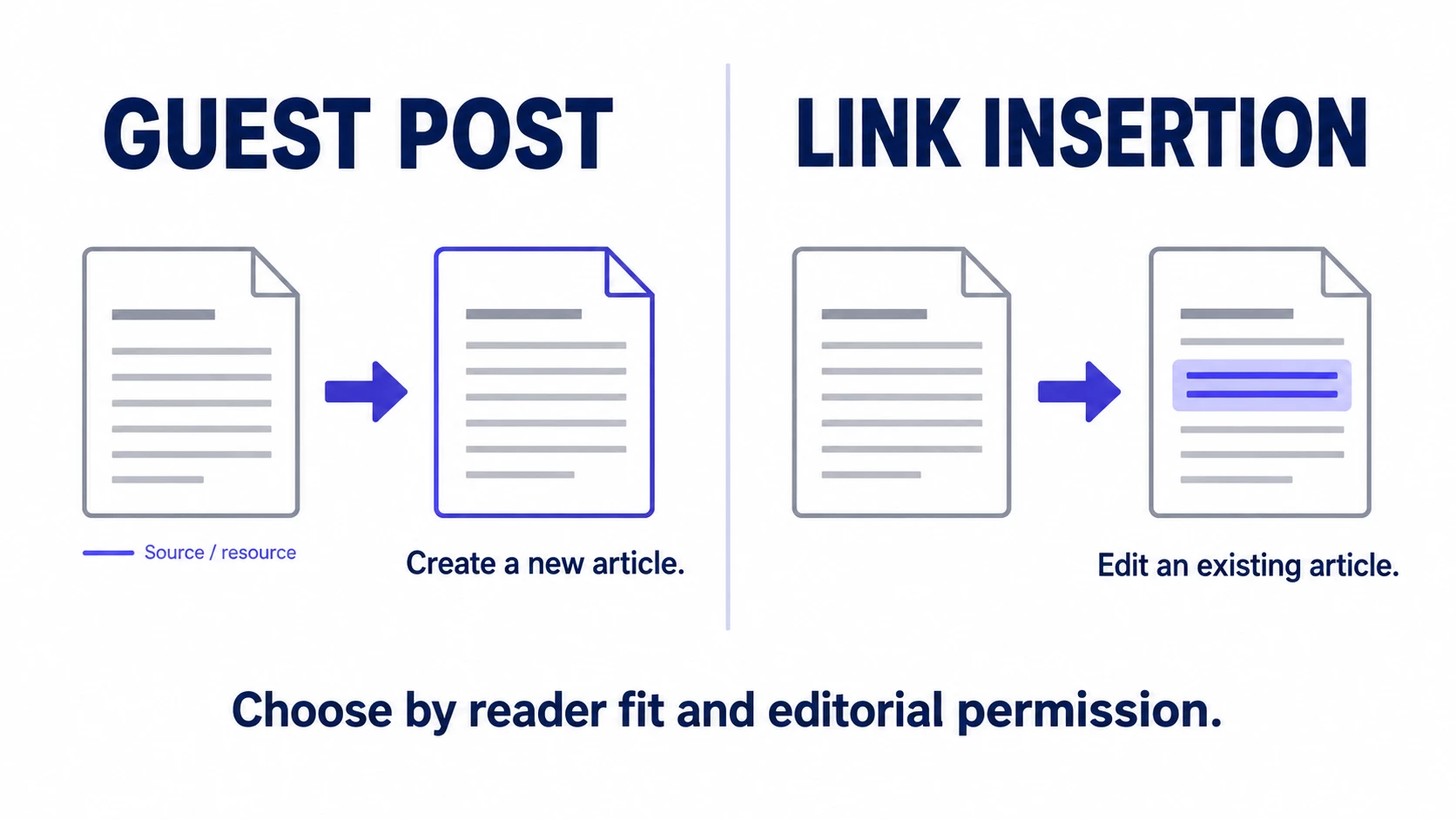
| Decision | Guest post | Link insertion |
|---|---|---|
| What is published? | A new article with an agreed angle | An edit to an identified existing article |
| What must you review? | Topic, outline, draft and editorial guidelines | Exact URL, surrounding passage and proposed edit |
| Where is your resource introduced? | Within a new explanation that earns its place in the article | Where it helps answer the existing reader's question |
| What work might be separately charged? | Research, writing, revisions, images or placement | Article discovery, passage editing, revisions or placement |
| What limits your control? | Publisher approval and editorial rules | The existing argument and the editor's permission to change it |
| What determines timing? | Draft preparation, editorial review and publication scheduling | Finding an appropriate article and obtaining edit approval |
When comparing niche edits vs guest posts, distinguish less content to prepare from a better publishing choice. A short edit can still require careful article selection and negotiation. A new article takes more preparation but may explain a subject that no existing page covers well.
Start with the target page and the reader
Identify the page you want readers to visit and why it would help them. A practical template, research report or product explanation needs different surrounding context. If you only know your brand domain, use it for initial discovery; confirm the specific target page before drafting or proposing an insertion.
Then check the publication at three levels:
- Publication: Does it serve an audience relevant to your business?
- Section: Is there an editorial category that can reasonably cover your subject?
- Article: Will this particular story or passage give readers a reason to use your resource?
A business magazine can fit a software brand through a team-operations article. A technology label alone does not establish topical relevance. Likewise, an article mentioning “projects” is not necessarily suitable for project-management software if it is about a school craft activity.
Ahrefs defines Domain Rating as a relative measure of a domain's backlink profile. Use DR to check your stated threshold, then assess content fit separately. A domain score does not establish the traffic of the proposed article, editorial quality or the supplier's authority to publish.
For a fuller domain-level check, use the brand buyer's guide to evaluating guest posting sites. Complete that screening before deciding that either format is worth buying.
Before drafting either format, check reader and destination fit using the publication, article and target page together.
What each deliverable looks like
Consider a fictional project-planning software brand. Its audience is small agencies, and its target resource is a guide with a downloadable project-planning template. All titles, passages and quotes below are self-written illustrations, not real publisher offers or customer results.
Option A: commission a new guest post
A workable brief might contain:
- Proposed title: How Small Agencies Keep Client Projects on Schedule.
- Reader problem: Teams lose track of milestones when work moves between colleagues.
- Outline: Set milestones; assign owners; review risks during a weekly planning meeting.
- Contribution: Explain the process with a useful worked example rather than a product promotion.
- Target resource: Introduce the planning template where readers need a way to apply the process.
- Questions for the publisher: Does this topic fit the section? What length, attribution, link attributes and disclosure are required?
The buyer's job is to agree on the idea before paying for a full draft. Ask for the publisher's actual guidelines and confirm who handles revision requests. “Guest post available” does not establish that the publisher will accept your chosen angle, target page or anchor text.
A useful final handoff contains the approved title, article draft, sources, intended target URL and any required author or disclosure information. It is still a draft for editorial review, not proof that publication has occurred.
Option B: propose an edit to an existing article
Suppose the supplier identifies an article about weekly client reporting. Its planning section already discusses milestones and assigned owners. The illustrative edit could be:
Original passage
Before sending your weekly client update, review the project milestones and the person responsible for each task. This keeps the report focused on progress, risks and the next decisions.
Proposed replacement passage
Before sending your weekly client update, review the project milestones and the person responsible for each task. A project planning template can help you record those milestones and owners before summarizing progress, risks and the next decisions.
Proposed anchor: “project planning template,” pointing to the brand's relevant template guide. It is shown as text here because this example has no live publisher or target URL.
The addition belongs because it helps readers perform an existing task. It does not introduce unsupported product claims or switch the paragraph into an advertisement for unrelated software.
For a real insertion proposal, supply the exact source article URL, original passage, whether the edit is an addition or replacement, proposed wording, anchor and target URL. A supplier can then discuss a specific change with the editor. Avoid approving “any suitable article on this domain”; the article is a material part of the opportunity.
When no suitable article exists
A domain can be relevant while its available articles are unsuitable. The supplier may have no editing access to the page you found. An apparently promising passage may become inaccessible before you can verify it.
Use this order of action:
- Ask for another relevant article on the same publication, with its exact URL.
- If the publication accepts new contributions, consider a guest-post topic that serves its readers.
- If neither option has a convincing editorial fit, decline that opportunity.
Do not invent an article, rewrite unrelated content around your link, or treat an unavailable page as evidence that the publisher is low quality. An access failure leaves the insertion unverified. You can keep the domain under consideration while looking for usable evidence.
Compare the full cost, not just the placement fee
Guest post cost and insertion cost depend on the work included in the quote. Ask both suppliers the same questions: is writing included, who chooses the article, how many edits are allowed, and what happens if the editor rejects the contribution?
Total spend = platform fee, if used + supplier placement fee + separately agreed writing, editing or other charges.
Here is an illustrative comparison for the fictional brand, assuming one selected opportunity and no additional writing or editing fee:
| Cost item | Guest post example | Link insertion example |
|---|---|---|
| Supplier placement fee | $150.00 | $120.00 |
| One platform opportunity credit | $9.90 | $9.90 |
| Separately charged writing or editing | $0.00, assumed | $0.00, assumed |
| Total under these assumptions | $159.90 | $129.90 |
The supplier amounts are invented for arithmetic, not market averages, real offers or evidence that insertion is generally cheaper. If guest-post writing costs another $80, the first total becomes $239.90. If the insertion quote includes a separate research fee, add that too.
As checked on 6 October 2026, Linkquire's early-access platform price is $9.90 for one opportunity credit or $19 for two, purchased once rather than as a subscription. One credit unlocks one qualifying domain, placement format and quote. Selecting guest post and insertion quotes on the same domain separately uses two credits. Buying credits does not pay the supplier or publish an article.
For a reusable fee breakdown and further examples, budget for placement and content fees separately before comparing offers.
Questions to confirm before paying
A promising format and an affordable quote still need clear publishing terms. Use these questions in your supplier outreach:
- Authority: Are you the publisher or a reseller? Can you obtain approval for this new article or this specific existing-page edit?
- Deliverable: Which section or source article is agreed? Who writes, edits and submits the content? Is a byline included if needed?
- Target and anchor: Will the editor accept the proposed destination and wording? May they change either, and will you review material changes?
- Commercial disclosure: How will the publication identify the paid collaboration? Which link attribute will be used?
- Timing: What is the expected review and publication window? What happens if the deadline is missed or the editor rejects the submission?
- Changes after publication: What retention, correction, replacement or refund terms does the supplier offer? Get any promise in writing instead of assuming permanent placement.
- Verification: Will the supplier send the live URL so you can check the article, destination, surrounding text, disclosure and link attributes?
Paid format does not make ranking manipulation acceptable. Google's link-spam policy addresses buying or selling links for ranking purposes and distinguishes appropriately qualified advertising or sponsorship links. Its guidance on outbound link attributes recommends rel="sponsored" for paid placements; nofollow remains acceptable.
Apply those conditions to either format. A relevant article or an old indexed page does not remove the need to qualify a paid link. Do not treat a supplier's “dofollow” promise as a guarantee of rankings, traffic or safety.
A practical selection workflow
Write a brief that states your business, intended reader, target resource, article language, placement budget and optional minimum DR. Choose a global audience or specify the countries that matter to the campaign. A supplier's home country does not establish the publication's audience.
Ask suppliers to state Guest Post, Link Insertion or Both and quote each format separately. Review the publisher first; for insertion, review the article and passage as well. Then compare the included work and resolve the questions that could change your decision.
You can record separate quotes and evidence before choosing a format or requesting missing information.
In the platform, qualifying opportunities can be unlocked for the full assessment and content preparation. A confirmed target page is needed for guest-post drafting or an insertion plan; insertion also needs a suitable source article. You choose the supplier, confirm publication and pay their fee directly. The Linkquire publishing workflow and fee explanation sets out those responsibilities.
Your next message to a supplier should ask for an exact article URL or an agreed guest-post brief. That makes the conversation about a deliverable you can review.
Frequently asked questions
Is link insertion better for SEO than a guest post?
Neither format establishes a better result by itself. Evaluate the publication, page context, contribution and publishing terms. No format guarantees search visibility or ranking improvement.
Is link insertion always cheaper or faster?
No. It may involve less new writing, but finding a suitable page and obtaining editorial approval take work. Compare actual quote inclusions and agreed timelines rather than assuming a universal price or speed advantage.
Does an existing indexed article mean immediate results?
No. Existing indexation does not guarantee when Google will crawl an edit or whether it will affect search results. New guest posts also have no guaranteed indexing schedule. Do not use article age as a substitute for reader fit.
Should I accept Both from the same supplier?
You can compare both quotes. Review the new-article angle and the existing article independently; accept the format that fits the resource and terms. “Both” describes availability, not a recommendation to buy two placements.
What if the article or metrics cannot be verified?
Record the missing evidence. Ask for an accessible same-site article or a current metric source and measurement date. Unknown DR or traffic is not zero, and an unreadable page is not automatically a quality failure. If minimum DR is a hard requirement, a failed lookup does not establish that the threshold is met; verification is still needed.
Before committing to either format, use the supplier confirmation checklist to confirm the actual location, link terms and delivery requirements.