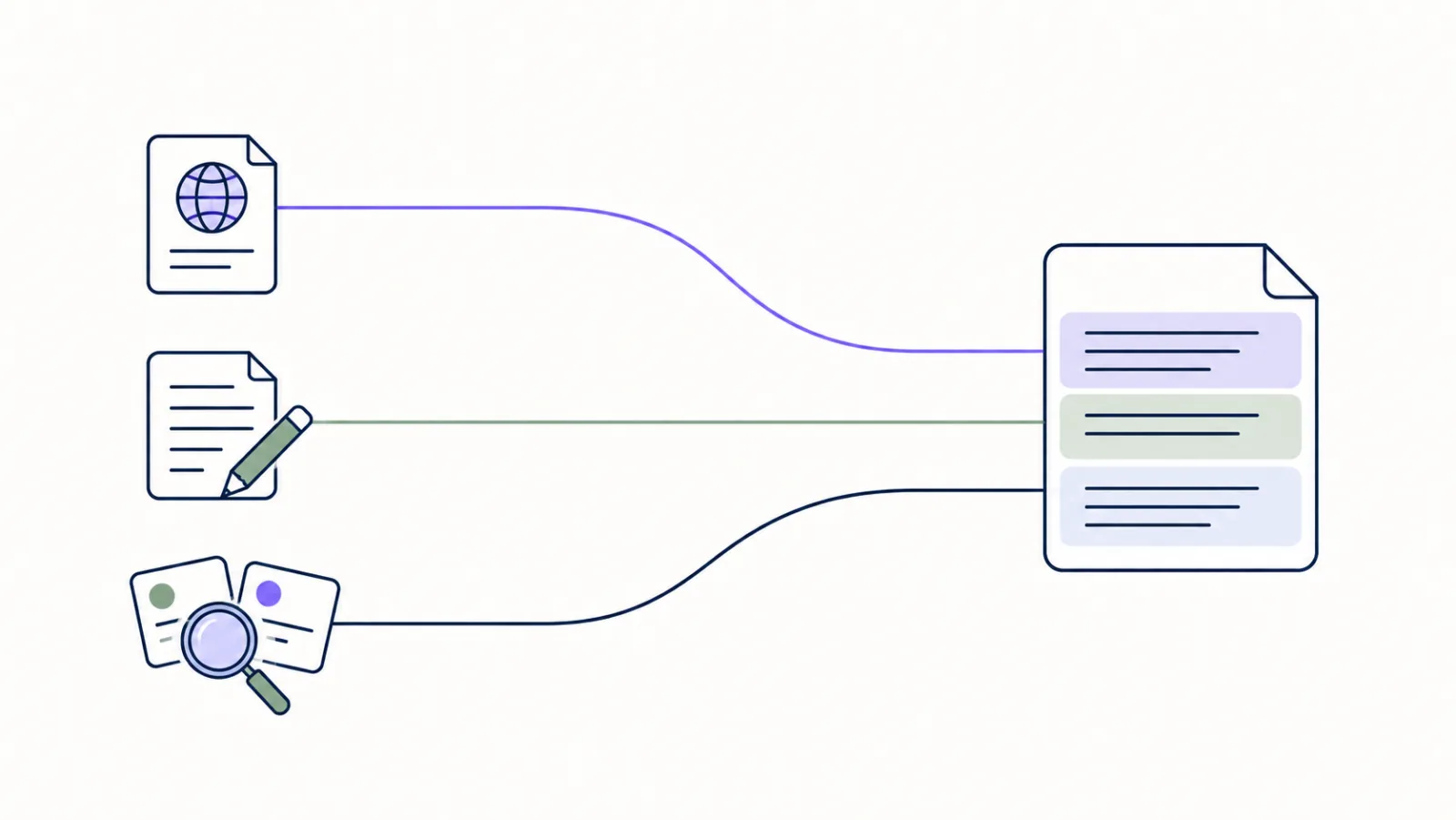
- Evidence of a real publication
- Metrics that meet your requirements
- A topic and article that fit your brand
A supplier quotes $150 for a guest post. Does that cover the article, revisions and publication—or only uploading a draft you provide? Guest post pricing becomes useful when the quote specifies what you receive, who does the work and which costs remain separate.
For a brand buyer, the useful number is the total cost of an agreed placement. Start with current written quotes for your requirements, rather than treating a domain score or an advertised starting price as a rate card. The budgets below demonstrate the calculation; they are not industry averages or actual supplier offers.
1. Split guest post pricing into deliverables
Ask for a quote for one defined placement: the publishing domain, format, article scope, target page and delivery conditions. “One guest post” can mean a supplied article published on a website, or a bundle that also includes research, writing and supplier coordination.
Copy these fee groups into your budget sheet:
| Fee group | What the payment buys | What to confirm |
|---|---|---|
| Placement | The agreed publication on the specified website | Whether uploading, publisher editing and any later correction are included |
| Content | Research, drafting, images or agreed revisions | Who supplies the draft, required length, revision rounds and image permissions |
| Coordination | Supplier sourcing, outreach, negotiation or project handling | Whether this is already bundled with placement, or charged separately |
| Platform | Access, assessment, contacts or a content plan, depending on the service | Whether the fee buys an opportunity or includes actual publication |
| Applicable extras | Taxes, payment processing or currency conversion | Invoice currency, which charges apply and the amount actually payable |
Mark each item included, separate, optional, unknown or not applicable. Add a separately billed item once. If writing is included in a package, record that fact rather than adding another writing fee. A blank cell should not silently become $0.
Record who receives each payment. A reseller can offer a valid placement, but its invoice is not necessarily the publisher’s own fee. You need the final scope and payment recipient, not an assumption about its internal margin.
If a publisher accepts your contribution with no placement charge, budget any remaining writing and coordination work. Supplying a draft also takes team time, even when no cash changes hands.
2. Check publisher fit before comparing prices
A cheaper quote is useful only if it meets the brief. Check the publication’s subject, content language and audience, then read recent articles in the relevant section. Can the proposed article explain something useful to those readers? Is there a plausible reason for a reader to visit your target page?
Treat Domain Rating (DR) and Domain Authority (DA) as third-party metrics, not promises about publication quality or SEO results. Use the requested metric to check your threshold; neither score verifies the supplier’s authority to arrange publication. A higher score alone does not explain why you should pay more.
For traffic estimates, retain the source, retrieval date, reporting period and country/device/domain scope. Estimated total visits and organic-search traffic measure different things; neither gives you the audience of a future article. Missing traffic data stays unknown.
Read the actual editorial evidence, including any specific spam or private blog network (PBN) concerns. An unreadable page is unverified, and one suspicious signal is not a confirmed network. The guest post quality checklist provides a sheet for keeping that evidence alongside each quote.
Shortlist suitable offers before trying to negotiate their price. A discount cannot fix an unrelated audience or unavailable placement.
3. Calculate the full budget from written quotes
Use this calculation for your cash budget:
Total guest post cost = placement + separately billed content + separately billed coordination + platform purchases + applicable extra charges.
The supplier and writing amounts below are fictional. For arithmetic only, each example assumes one $9.90 platform-credit purchase, with coordination included and no extra tax, payment or currency charge. That platform price is the current single-credit option described in step 6; it is not the cost of publication.
| Illustrative offer | Placement or bundle | Additional writing | Total cash budget |
|---|---|---|---|
| A: You supply an accepted draft | $150 placement | $0 externally billed | $159.90 |
| B: Writing is separately billed | $120 placement | $70 writing | $199.90 |
| C: Writing is included | $180 writing-and-placement bundle | $0 additional | $189.90 |
Offer B has the lowest placement fee but the highest total in this example. Offer A needs your own drafting and editing capacity; the $0 column does not value that labor at zero. Offer C’s writing is already in its $180 bundle.
These offers demonstrate accounting, not a quality ranking. Compare the word count, research, revisions, timing and publication terms before deciding which scope you want. An AI draft may still need fact checking and publisher changes; outsourcing those tasks can create a separately agreed cost.
When an amount is unknown, keep the total provisional. Ask for the missing fee before committing, or set an internal reserve clearly labeled as your planning assumption. Do not present that reserve as a supplier quote. Record the quote date and expiry, and reconfirm the total if the currency or scope changes.
4. Request a separate quote for link insertion
A domain that supports both formats is offering two possible arrangements. A guest post requires a new article; a link insertion requires an existing article, a relevant passage and permission to edit it.
For insertion, request the exact article URL, proposed addition, anchor text, destination and price. Include any content-editing charge in its budget. “We can insert a link on this domain” is insufficient to assess a specific placement.
Do not assume insertion is always cheaper. It may need less new copy, but you still need a suitable article and agreed editorial conditions. If there is no suitable article, keep the insertion option unavailable rather than estimating savings from a hypothetical placement.
Keep Guest Post and Link Insertion as separate quote rows, including when one supplier offers Both on the same website. The comparison of link insertion and guest posting explains which deliverables you should compare. Paying for both means two agreed placements, not a free extra link.
5. Confirm the terms before paying
Ask the supplier to confirm availability and authority to arrange the specified placement. Agree on the draft or editing scope, publication deadline, target URL, anchor text and link attributes. Check when payment is due, whether a deposit is required, and what happens if the publisher rejects the draft or misses the deadline.
Link attributes affect the arrangement you are buying. Google’s link-spam policy treats buying links to manipulate rankings as link spam. Its outbound-link guidance prefers rel="sponsored" for paid placements and also accepts nofollow. A “dofollow” sales label does not establish policy compliance or guarantee ranking credit.
Use a focused message rather than asking for a general assurance:
Please confirm the publishing domain and placement format, final price in USD, and whether writing, uploading, revisions and coordination are included. Specify any separate charges and the payment deadline or deposit requirements. Confirm your authority to arrange publication, the agreed target URL, anchor and link attributes, and the expected publication date. If the draft is rejected, the placement is not delivered or the link is later removed, what correction, replacement or refund terms apply?
Retain the response with the quote. If a supplier describes a placement as permanent, ask how removal or a publisher ownership change is handled. No duration promise establishes future availability or search indexing.
Do not pay a premium for a promised ranking increase. Budget for the confirmed editorial deliverable and evaluate results separately. The useful negotiation is a clearer scope or workable correction terms, not a lower price for an unresolved offer.
6. Budget opportunity unlocks separately from publication
Linkquire separates the platform fee from supplier payment. You can publish a request and compare qualifying quotes before choosing an opportunity to unlock. An unlock provides the full assessment, supplier contact and content-plan entitlement. It does not purchase publication or pay the supplier.
A verified buyer receives two lifetime free opportunity unlocks, with no card or automatic charge required. Earlier gifted credits count toward that cumulative allowance; spending them or logging in again does not renew it. Supplier placement fees remain payable separately during the trial.
Prices are current as of October 10, 2026; check the latest purchase screen before paying:
- $9.90 for one credit. It can unlock one independent qualifying proposal.
- $19 for two credits. This is a one-off package, not a subscription. It allocates to $9.50 per unlock only when both credits are used.
Two fictional $150 placements plus the $19 package produce a $319 cash budget when no other fees apply. If you buy that package but arrange only one $150 placement, current cash outlay is $169 and one credit remains. An eligible free unlock with that same placement costs $150 in cash under those assumptions. Current early-bird credits do not expire.
Different suppliers or formats on the same domain remain independent proposals, each using its own credit when unlocked. Guest Post plans support AI article drafts; Link Insertion plans depend on a suitable readable article. Confirm acceptance with the supplier before commissioning extra writing.
If an unlocked quote proves inaccurate, a verified discrepancy can restore the platform credit; the current mechanism does not issue a cash refund. Agree on remedies for actual publication directly with the supplier.
Start by writing down your placement budget and collecting comparable proposals. The buyer guide explains verification, credits and content preparation so you can test an opportunity before buying more platform capacity.