- Evidence of a real publication
- Metrics that meet your requirements
- A topic and article that fit your brand
A supplier sends a list of domains, DR scores and prices. Which offer should you discuss first? This guest post quality checklist helps brand buyers record the evidence behind each offer, separate guest-post and link-insertion prices, and identify the question that still needs an answer.
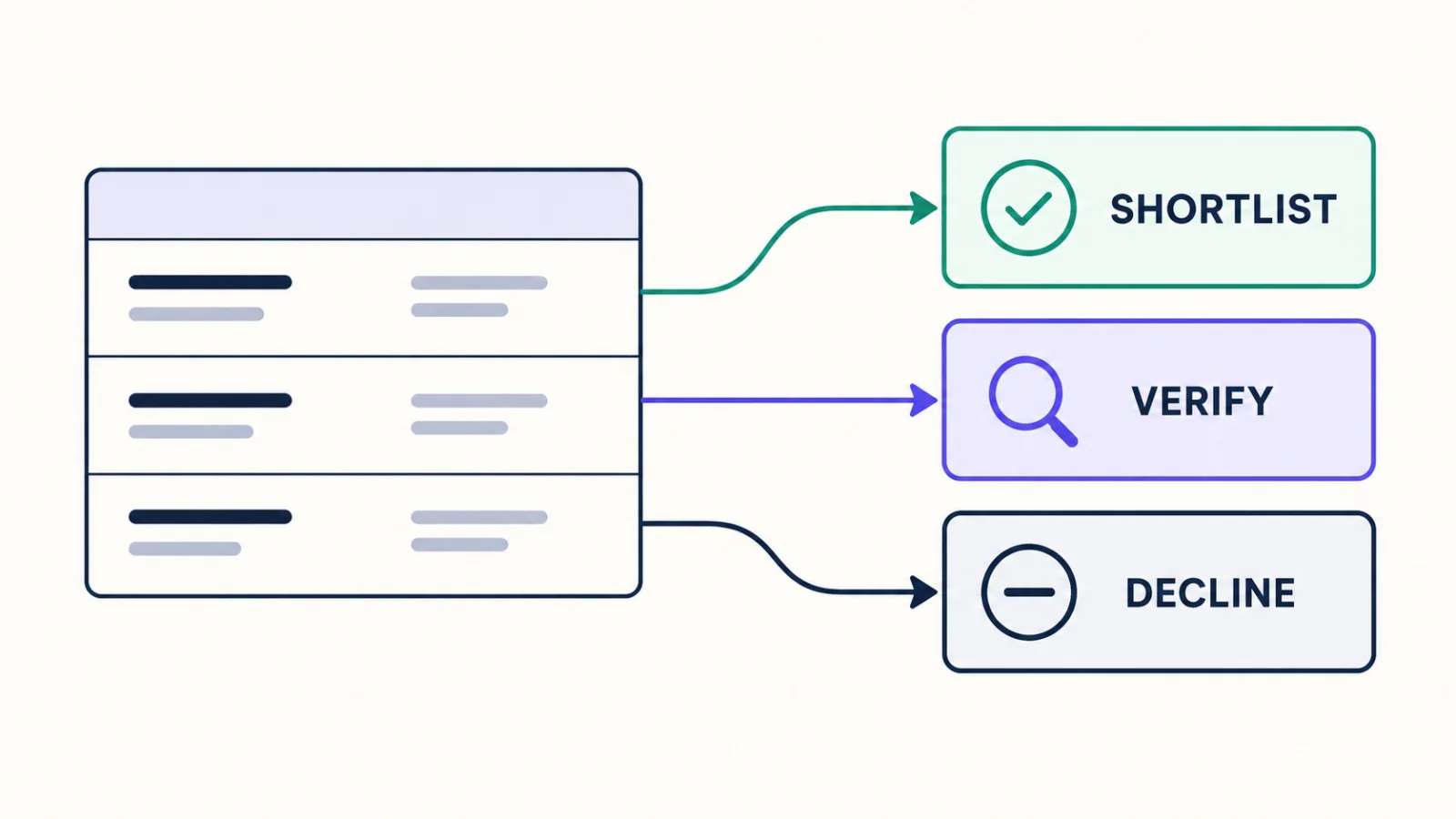
Start with your requirements, check current evidence, then give each publishing opportunity a next action: shortlist, verify or decline. A high domain score alone cannot tell you whether the publication, article or supplier fits your needs.
1. Copy the guest post quality checklist into a sheet
Write your requirements above the table: business and target page, content language, audience or countries, placement budget and optional minimum Ahrefs DR. Use Global when there is no country restriction. These are your criteria for this request.
Create the columns below. Keep one row per domain and supplier, with separate prices and decisions for each supported format. Both means two potential placements, each needing its own review. Keep competing suppliers as separate rows; standardize the hostname for comparison, while retaining the exact sample URLs and any subdomain scope.
| Column group | Fields to record | What the record should answer |
|---|---|---|
| Offer | Domain, supplier, Guest Post / Link Insertion / Both, each price, quote expiry | What is being offered, by whom, and for how much? |
| Metrics | Minimum DR, Ahrefs DR and check date; traffic estimate, source, reporting period, retrieval date, country and domain/device scope | Are these numbers comparable and relevant to this request? |
| Content evidence | Recent editorial article URLs, audience, category, business-fit reason | Where does this publication serve readers interested in your subject? |
| Insertion evidence | Existing article URL, relevant passage, proposed edit | Can your resource help a reader at this specific point? |
| Terms | Publishing authority status, content and link conditions, included fees, delivery timing | What remains subject to publisher approval? |
| Follow-up | Separate next action for each format, missing evidence, person responsible and follow-up date | What should happen before you commit? |
Write unknown for missing facts. Blank cells otherwise make it hard to distinguish “not checked” from “not offered.”
Download the CSV worksheet. It contains the column headers; use the fictional example below to guide your entries.
2. Check evidence before sorting by DR or price
First check the metric labels. Ahrefs defines Domain Rating as a relative measure of a domain’s backlink profile. DR is Ahrefs’ metric, not Google’s. Check your stated minimum, but assess editorial quality and business relevance separately. A column labeled DA is not a substitute for the DR you requested.
For traffic, distinguish estimated total visits from estimated organic-search traffic. Record the retrieval date separately from the reporting period; if either is unavailable, write unknown. Compare the same period, country, device and domain scope; neither number establishes how many people read the proposed article. A traffic trend needs multiple comparable periods. Similarweb explains that insufficient data can prevent a reliable estimate. Record that limitation rather than entering zero or demanding screenshots from every supplier.
Read recent articles in the relevant section. Can you identify the publication, its authors and editorial purpose? Would your target page help those readers? For insertion, read the proposed passage as well. A broad technology category does not make every article suitable for your software brand.
Record specific concerns: an unexplained topic change in the site’s history, unrelated commercial links across recent articles, or content with no useful editorial purpose. These can justify further checks; one signal does not prove a private blog network (PBN). An inaccessible page also remains unverified. A search result can help locate an article, but does not establish complete index coverage or guarantee that a future article will be indexed.
Use the guide to evaluating guest posting sites for deeper investigation. Keep this sheet focused on the evidence that changes your next decision.
3. Compare the quotes using a filled example
The following labels, prices, DR values and evidence are entirely fictional. They are not supplier listings, market averages or verified assessments. Assume a team-workflow software brand has set a $200 placement ceiling and minimum DR 40 for this request.
| Publication / supplier | Format and placement price | Fictional DR | Evidence or gap | Next action |
|---|---|---|---|---|
| A / Supplier 1 | Both: GP $180; insertion $100 | 48 | Relevant operations section and sample article; insertion URL not supplied | Shortlist GP for confirmation; verify insertion |
| A / Supplier 2 | GP $160 | 48 | Same publication; writing scope and authority to arrange publication unclear | Verify those terms before comparing the saving |
| B / Supplier 3 | GP $150 | 72 | Readable articles concern consumer fashion; no convincing workflow angle | Decline for this request |
| C / Supplier 4 | Insertion $90 | 35 | Relevant existing passage; DR below the buyer’s stated minimum | Decline under the current requirement |
“Shortlist” means worth discussing, not approved for payment. Publication A illustrates why a domain can fit while its insertion offer still lacks a usable article. B shows why a higher DR does not resolve weak relevance. C’s outcome reflects this buyer’s threshold, not a universal quality verdict.
If the formats are unfamiliar, the guest post and link insertion comparison explains what each deliverable requires.
4. Confirm the deliverable with the supplier
Send a focused request for the missing facts. For publication A, that could be:
Please confirm the Guest Post price and whether writing, revisions and publication are included. Who authorizes the placement, and is the proposed topic accepted? Please share the word-count guidelines, link attributes, permitted anchor text, disclosure requirements, publication timing and quote expiry. For Link Insertion, please send the exact article URL and passage the editor can approve. Please also confirm retention terms and the agreed remedy if publication does not happen or the placement is later removed.
A reseller can arrange a legitimate placement. Ask who can approve it and which conditions have been confirmed with the publisher; a sample article does not establish that authority.
For paid placements, Google’s outbound-link guidance recommends rel="sponsored"; nofollow is also acceptable. Record the agreed attributes and disclosure. A promised followed link is not proof of quality or a guarantee of ranking benefit.
5. Give each opportunity a next action
Use this backlink quality checklist to decide what to do next, without collapsing everything into a single score:
- Shortlist for confirmation: the evidence supports the audience and content fit, and the known price and metrics meet your requirements. Confirm outstanding publishing terms before payment.
- Verify: a fact needed for the decision is missing or inaccessible. Name it precisely, assign someone to obtain it, and set a follow-up date.
- Decline for this request: a confirmed requirement is not met, or the content has no reasonable connection to your business. Record the reason.
Replace “please provide more evidence” with a concrete request: “send a recent article from the relevant section” or “confirm who approves the insertion.” Recheck metrics and quote validity before committing if time has passed.
Turn the shortlist into a request
You can use the worksheet independently. For another route, Linkquire lets you publish a requirement, receive supplier proposals and review AI assessments before unlocking a qualified opportunity. Suppliers submit their domains and quotes; this worksheet is not a buyer import feature. A verified buyer receives two lifetime free opportunity unlocks. Supplier placement fees remain separate and are paid directly to the supplier, including during the trial. The buyer guide explains the steps from your first request to a content plan and delivery checks.